Homeschooling
How to Start Homeschooling: Beginner's Guide 2026
New to homeschooling? This complete beginner's guide covers legal requirements, curriculum choices, daily schedules and everything you need to start confidently in 2026.
📽️ 30-Second Summary
How to Start Homeschooling in 2026
A 10-year homeschool educator's complete beginner roadmap
Starting homeschooling can feel overwhelming, but it doesn't have to be. This complete beginner's guide walks you through every step — from understanding your state's legal requirements and choosing the right curriculum, to building a daily schedule that actually works. Whether you're pulling your child from public school or starting from kindergarten, this guide gives.
By Sarah Brennan, Homeschool Educator & Curriculum Consultant | Last updated: March 12, 2026
Table of Contents
- Why Families Choose Homeschooling in 2026
- Understanding Homeschool Laws by State
- How to Legally Withdraw Your Child from Public School
- Choosing a Homeschool Method
- Picking the Right Curriculum
- Setting Up Your Homeschool Space
- Creating a Daily Schedule That Works
- Socialization: Addressing the Biggest Concern
- Record-Keeping and Assessments
- Budgeting for Your First Year
- Common Mistakes to Avoid
- FAQs
- Sources & Methodology
Why Families Choose Homeschooling in 2026
Homeschooling has grown from a fringe movement to a mainstream educational choice. According to the National Center for Education Statistics, homeschooling rates have more than doubled since 2019, with an estimated 5–6 million students now learning at home across the United States.
Families choose homeschooling for a wide range of reasons:
- Personalized learning pace. Children who are ahead or behind grade level can move at their own speed without waiting for or being rushed by a classroom.
- Safety and well-being concerns. Bullying, school violence, and mental health issues in traditional schools drive many parents to seek alternatives.
- Religious or philosophical values. Some families want education aligned with specific belief systems or worldviews.
- Special needs accommodation. Children with learning differences, ADHD, autism, or giftedness often thrive with individualized instruction.
- Lifestyle flexibility. Military families, traveling families, and families with non-traditional work schedules benefit from a flexible school calendar.
- Dissatisfaction with local school quality. Overcrowded classrooms, limited resources, and low test scores push parents toward homeschooling.
Whatever your reason, the key takeaway is this: homeschooling is legal in all 50 states, and millions of families are doing it successfully right now. You can too.
Understanding Homeschool Laws by State
Before you buy a single textbook, you need to understand your state's homeschool laws. This is the single most important first step. Requirements vary dramatically from state to state.
Regulation Levels by State
| Regulation Level | What It Means | Example States |
|---|---|---|
| No notice required | You don't need to notify anyone that you're homeschooling | Texas, Alaska, Idaho, Indiana |
| Low regulation | You must notify the state or school district | California, Nevada, Nebraska, Kentucky |
| Moderate regulation | Notification plus test scores or professional evaluation required | Colorado, Florida, Oregon, South Carolina |
| High regulation | Notification, test scores, curriculum approval, and/or home visits | New York, Pennsylvania, Massachusetts, Vermont |
Key Legal Requirements to Research
For your specific state, you'll want to find answers to these questions:
- Do I need to file a notice of intent? Many states require you to submit a letter or form to your local school district or state department of education.
- Are there required subjects? Most states require instruction in math, reading/language arts, science, and social studies. Some add health, citizenship, or physical education.
- Do I need to keep records? Some states require attendance logs, portfolios of student work, or curriculum descriptions.
- Are assessments mandatory? Certain states require standardized testing, portfolio reviews, or evaluations by a certified teacher.
- Do I need specific qualifications? A few states require the teaching parent to have a high school diploma or GED. Most do not require a teaching certificate.
The Homeschool Legal Defense Association (HSLDA) and your state's department of education website are the most reliable sources for up-to-date legal information. Laws change, so verify every year.
How to Legally Withdraw Your Child from Public School
If your child is currently enrolled in a public or private school, you'll typically need to formally withdraw them before beginning homeschooling. Here's a general step-by-step process:
- Research your state's withdrawal process. Some states require a written withdrawal letter; others handle it through the homeschool notification process.
- Write a formal withdrawal letter. Address it to the school principal. State your child's name, grade, the effective date of withdrawal, and that you intend to homeschool. Keep a copy for your records.
- File your notice of intent to homeschool (if required by your state). This is separate from the withdrawal letter.
- Request your child's records. Ask for transcripts, immunization records, and any IEP/504 documentation.
- Return school property. Textbooks, library books, technology devices, uniforms, and ID badges.
- Get written confirmation. Ask the school for written acknowledgment that your child has been officially withdrawn.
A common mistake is simply stopping attendance without formally withdrawing. This can trigger truancy proceedings. Always follow the proper process.
Choosing a Homeschool Method
One of homeschooling's greatest strengths is the ability to tailor your approach to your child's learning style. Here are the most popular homeschool methods:
Method Comparison Table
| Method | Best For | Structure Level | Key Feature |
|---|---|---|---|
| Traditional / Textbook | Families wanting a school-at-home feel | High | Follows a structured, grade-level curriculum |
| Charlotte Mason | Literature-loving, nature-oriented families | Medium | Living books, narration, nature study |
| Classical | Academically rigorous families | High | Trivium stages: grammar, logic, rhetoric |
| Montessori | Self-directed learners, younger children | Medium | Hands-on, child-led, prepared environment |
| Unschooling | Highly self-motivated, curiosity-driven kids | Low | Child-directed, interest-led learning |
| Eclectic | Families who want to mix and match | Varies | Combines elements from multiple methods |
| Unit Studies | Multi-age families, project-based learners | Medium | Integrates subjects around a central theme |
| Online / Virtual School | Tech-savvy families, working parents | High | Pre-built digital curriculum with teacher support |
You don't have to choose just one method, and you don't have to stick with your first choice forever. Most experienced homeschool families end up using an eclectic approach — pulling what works from different methods and discarding what doesn't.
For a deeper look at how to match curriculum to your child's learning style, see our guide on best-homeschool-curriculum-2026.
Picking the Right Curriculum
Choosing curriculum is one of the most exciting — and potentially paralyzing — decisions you'll make. Here are the key factors to consider:
Factors to Evaluate
- Your child's learning style. Visual learners do well with video-based programs. Kinesthetic learners need hands-on activities. Auditory learners benefit from lectures and audiobooks.
- Your teaching style. Do you want a fully scripted, open-and-go curriculum? Or do you prefer the flexibility to design your own lessons?
- Your budget. Curriculum costs range from free (library + online resources) to $2,000+ per year for premium all-in-one programs.
- Secular vs. faith-based. Some curricula are explicitly Christian, Jewish, Islamic, or secular. Choose what aligns with your family's values.
- Grade level and subject. Your child may be at different levels in different subjects. That's perfectly fine — and one of homeschooling's advantages.
Popular Curriculum Options at a Glance
| Curriculum | Type | Grade Range | Price Range | Best For |
|---|---|---|---|---|
| Math-U-See | Mastery-based math | K–12 | $100–$200/yr | Visual/kinesthetic math learners |
| Teaching Textbooks | Online math | 3–12 | $70–$85/yr | Independent math learners |
| Sonlight | Literature-based, all subjects | PreK–12 | $500–$1,500/yr | Families who love reading |
| The Good and the Beautiful | All subjects, faith-based | K–8 | Free–$50/yr | Budget-conscious families |
| Time4Learning | Online, all subjects | PreK–12 | $20–$30/mo | Working parents, tech-savvy kids |
| Oak Meadow | Waldorf-inspired, secular | K–12 | $300–$800/yr | Creative, nature-oriented learners |
| All About Reading | Phonics/reading program | PreK–4 | $100–$200 | Early readers, struggling readers |
Don't feel pressured to buy an all-in-one package. Many families mix and match — using one publisher for math, another for language arts, and free resources for science and history.
For our full, detailed breakdown, visit best-homeschool-curriculum-2026.
Setting Up Your Homeschool Space
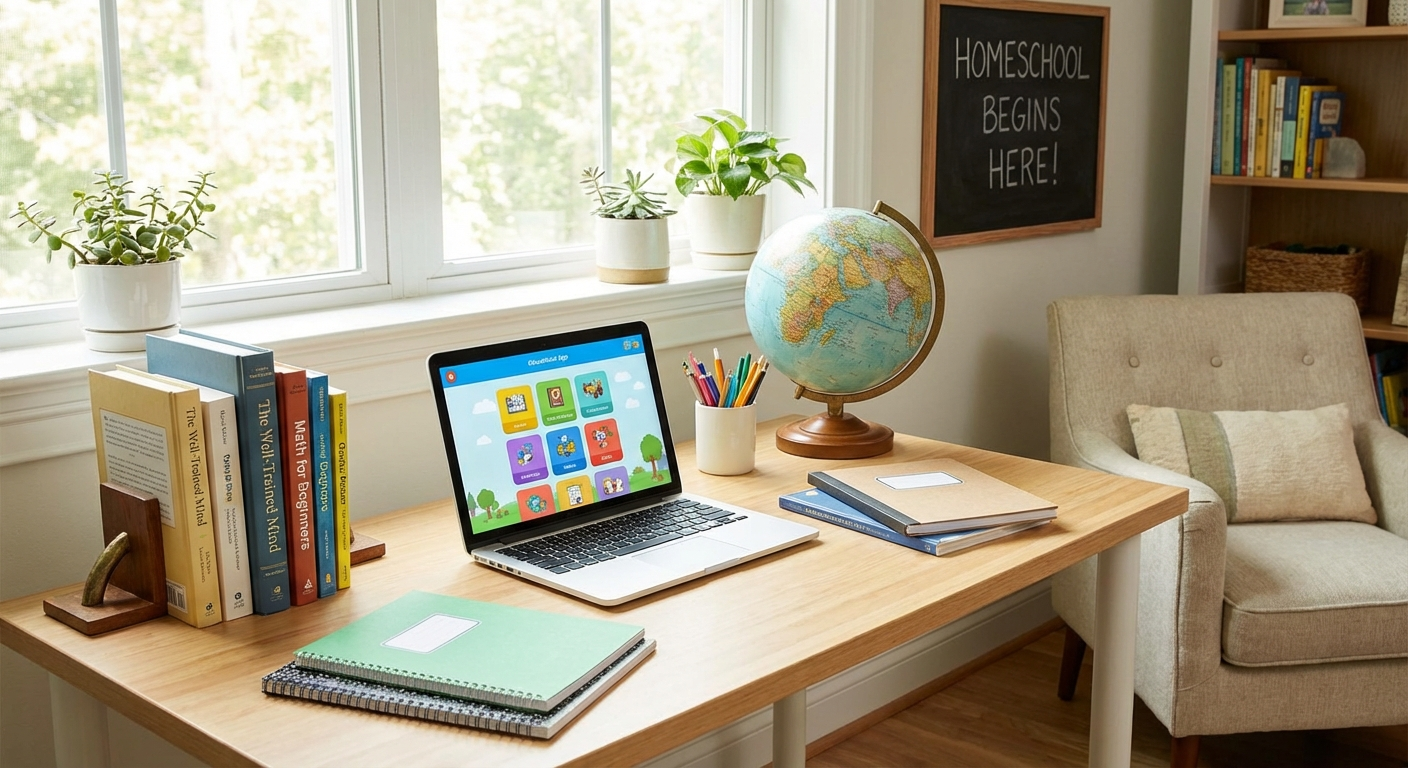
You don't need a dedicated classroom. You need a functional, distraction-reduced space where learning can happen consistently. Here's what works:
Essential Supplies
- A table or desk with good lighting
- Basic school supplies (pencils, paper, notebooks, art supplies)
- A bookshelf or storage bins for organizing materials
- A whiteboard or bulletin board (helpful but optional)
- A computer or tablet with internet access (for online resources and research)
- A printer (saves money on worksheets vs. buying workbooks)
Space Tips
- Use what you have. The kitchen table works perfectly well. Many experienced homeschool families never move beyond it.
- Create zones, not rooms. A reading nook, a science/art corner, and a desk area can all exist within a single room.
- Minimize distractions. Turn off the TV, put away toys during school hours, and limit phone access during focused learning time.
- Make materials accessible. Children who can independently grab their own books, supplies, and assignments develop ownership over their learning.
Creating a Daily Schedule That Works
This is where many new homeschool families struggle. They either over-schedule (trying to replicate a full 8-hour school day) or under-schedule (losing structure entirely within weeks).
The reality: most homeschool families spend 2–4 hours per day on formal academics for elementary-age children, and 3–5 hours for middle and high school students. One-on-one instruction is far more efficient than classroom teaching.
Sample Schedule for Beginners
| Time Block | Activity | Duration |
|---|---|---|
| 8:30–9:00 AM | Morning routine / calendar / read-aloud | 30 min |
| 9:00–9:45 AM | Math | 45 min |
| 9:45–10:00 AM | Break / snack | 15 min |
| 10:00–10:45 AM | Language Arts (reading, writing, grammar) | 45 min |
| 10:45–11:15 AM | Science or History (alternating days) | 30 min |
| 11:15 AM–12:00 PM | Electives (art, music, PE, foreign language) | 45 min |
| 12:00 PM | Lunch and free time | — |
This is a starting point. Adjust it based on your child's age, attention span, and your family's natural rhythms. Some families do school in the afternoon. Some split it into two blocks. There's no wrong answer as long as learning happens consistently.
For ready-to-use templates you can download and customize, see homeschool-daily-schedule-template.
Socialization: Addressing the Biggest Concern
"What about socialization?" is the question every homeschool parent hears. Here's the honest answer: socialization requires intentional effort, but it's entirely achievable — and many homeschooled children develop stronger social skills than their traditionally schooled peers.
Socialization Opportunities
- Homeschool co-ops. Groups of families who meet weekly for classes, field trips, and group activities. Most areas have multiple co-ops.
- Sports leagues. Many states allow homeschooled students to participate in public school sports. Community sports leagues are another option.
- Community classes. Art studios, music schools, martial arts dojos, swim teams, dance studios, and theater programs.
- Scouts, 4-H, and other youth organizations. Structured programs with peer interaction and leadership development.
- Church or community groups. Youth groups, volunteer organizations, and community service projects.
- Park days and playdates. Informal gatherings with other homeschool families.
- Part-time enrollment. Some states allow homeschooled students to attend public school part-time for specific classes (band, lab sciences, advanced math).
Research from the National Home Education Research Institute (NHERI) consistently shows that homeschooled students are well-socialized and tend to be more engaged in community and civic activities as adults.
Record-Keeping and Assessments
Even if your state doesn't require extensive records, keeping organized documentation protects you legally and helps you track your child's progress.
What to Keep
- Attendance log. A simple calendar marking school days is sufficient in most states.
- Curriculum list. Document what curriculum and materials you use each year.
- Work samples. Save representative samples of your child's work across subjects — writing samples, math tests, science projects, art.
- Reading logs. Track books read, especially for literature-heavy approaches.
- Grades or evaluations. If you assign grades, keep a record. If you use narrative evaluations, document those.
- Standardized test scores. If your state requires testing, keep official copies of all results.
- Transcripts (high school). Essential for college applications. Start building a transcript in 9th grade.
Assessment Options
| Assessment Type | Description | Best For |
|---|---|---|
| Standardized testing | Iowa, Stanford, CAT, MAP tests | States that require testing; college-bound students |
| Portfolio review | A certified teacher reviews work samples | States that accept this; Charlotte Mason/unschool families |
| Curriculum-based assessments | Tests and quizzes built into your curriculum | Textbook and online learners |
| Narrative evaluations | Written progress reports by parent or evaluator | Younger students, interest-led learners |
Budgeting for Your First Year
Homeschooling costs vary enormously depending on your approach. Here's a realistic breakdown:
Cost Comparison Table
| Expense Category | Budget Approach | Mid-Range | Premium |
|---|---|---|---|
| Curriculum & materials | $0–$200 (library, free online) | $300–$800 | $1,000–$2,500 |
| Supplies (paper, art, science kits) | $50–$100 | $100–$250 | $250–$500 |
| Technology | Use existing devices | $200–$500 | $500–$1,200 |
| Co-op / class fees | $0–$100 | $200–$600 | $600–$2,000 |
| Extracurriculars | $100–$300 | $300–$800 | $800–$2,000 |
| Standardized testing | $25–$75 | $25–$75 | $25–$75 |
| Field trips | $50–$150 | $150–$400 | $400–$1,000 |
| Total estimated | $225–$925 | $1,275–$3,425 | $3,575–$9,275 |
Money-Saving Tips
- Use your public library. Libraries offer free books, audiobooks, e-books, educational DVDs, museum passes, and inter-library loans.
- Buy used curriculum. Homeschool curriculum resale groups on Facebook, Homeschool Classifieds, and Rainbow Resource are gold mines.
- Take advantage of free resources. Khan Academy, PBS LearningMedia, CK-12, and Crash Course cover almost every subject.
- Share costs with other families. Split the cost of co-op fees, field trips, and bulk supply orders.
- Check for state programs. Some states offer Education Savings Accounts (ESAs) or tax credits for homeschool expenses.
Common Mistakes to Avoid
After helping 200+ families launch their homeschools over the past decade, I see the same mistakes repeatedly. Here's what to watch out for:
- Trying to replicate public school at home. You don't need to fill 7 hours with desk work. Homeschooling is more efficient. Let go of the traditional school model.
- Buying too much curriculum upfront. Start with core subjects (math and language arts). Add as you go. You'll waste less money and feel less overwhelmed.
- Comparing your homeschool to others. Social media homeschool accounts are highlight reels. Your messy, imperfect days are normal.
- Neglecting your own well-being. Burnout is real. Build in breaks, get support from other homeschool parents, and don't be afraid to take a day off.
- Skipping the legal requirements. Non-compliance can result in truancy charges. Do your homework on the law before you start.
- Not connecting with other homeschool families. Community is essential — for your kids and for you. Find your people early.
- Being too rigid or too unstructured. Aim for a flexible routine, not a rigid schedule or total chaos. Consistency matters more than perfection.
FAQs
Is homeschooling legal in all 50 states?
Yes. Homeschooling is legal in all 50 U.S. states and in most countries worldwide. However, laws and regulations vary significantly from state to state. Some states have no requirements beyond parental notification, while others require standardized testing, curriculum approval, or evaluations. Always check your specific state's current homeschool laws before beginning.
Do I need a teaching degree to homeschool my child?
No. The vast majority of states do not require any specific educational credentials to homeschool. Some states require a parent to have a high school diploma or GED. A few states have additional requirements, but a teaching certificate is almost never mandatory. Research shows that parent education level has minimal impact on homeschool student achievement.
How much does homeschooling cost per year?
Homeschooling costs range from nearly free to several thousand dollars per year. A budget-conscious family using free online resources and library materials can homeschool for $200–$900 per year. A mid-range approach with purchased curriculum, co-op fees, and extracurriculars typically costs $1,300–$3,500. Premium programs with online academies and extensive activities can run $3,500–$9,000+. Most families find their sweet spot in the $500–$1,500 range.
How many hours per day should we do school?
Most homeschool families spend 2–4 hours per day on formal academics for elementary students and 3–5 hours for middle and high school students. One-on-one instruction is significantly more efficient than classroom teaching, so you don't need to fill a traditional 7-hour school day. Quality of instruction matters far more than quantity of time.
Can homeschooled students get into college?
Absolutely. Homeschooled students are accepted at colleges and universities across the country, including Ivy League schools. Many colleges actively recruit homeschooled students. Admissions typically require SAT/ACT scores, a parent-created transcript, a portfolio or course descriptions, and recommendation letters. Some schools may request additional documentation such as a GED or subject-specific SAT Subject Tests.
What about socialization for homeschooled kids?
Socialization is one of the most common concerns, but research consistently shows that homeschooled children are well-socialized. The key is intentional effort: joining homeschool co-ops, participating in community sports and activities, attending youth group events, and arranging regular playdates. Homeschooled children often interact with a wider age range than traditionally schooled peers, which develops stronger social skills.
Can I homeschool if I work full-time?
Yes, but it requires creative scheduling. Options include homeschooling in the evenings or on weekends, using a self-paced online curriculum, enrolling in a hybrid school (part-time classroom, part-time home), sharing teaching duties with a spouse or co-op, or hiring a tutor. Many working parents successfully homeschool — it just looks different from a traditional stay-at-home model.
Sources & Methodology
This guide is based on my 10 years of experience as a certified homeschool educator and curriculum consultant, working directly with over 200 families across diverse backgrounds, budgets, and learning styles. In addition, the following sources informed the statistics and recommendations in this article:
- National Center for Education Statistics (NCES). "Homeschooling in the United States." U.S. Department of Education, 2023–2025 data releases.
- National Home Education Research Institute (NHERI). Peer-reviewed research on homeschool outcomes, socialization, and academic achievement. nheri.org.
- Homeschool Legal Defense Association (HSLDA). State-by-state homeschool law summaries. hslda.org.
- Coalition for Responsible Home Education (CRHE). Research and policy analysis on homeschool regulations. responsiblehomeschooling.org.
- State Departments of Education. Individual state education agency websites for current legal requirements and compliance procedures.
- Ray, B.D. "A Systematic Review of the Empirical Research on Selected Aspects of Homeschooling as a School Choice." Journal of School Choice, 2017.
- Curriculum publisher websites and pricing data verified as of February 2026.
All pricing and legal information was verified against primary sources as of March 2026. Laws and prices change — always confirm with your state's education department and curriculum publishers for the most current information.
Written by Sarah Brennan, certified homeschooling educator and curriculum consultant with 10 years of experience helping 200+ families build successful homeschools.
<!-- article_schema -->{
"@context": "https://schema.org",
"@type": "Article",
"headline": "How to Start Homeschooling: Complete Beginner's Guide (2026)",
"description": "Everything you need to start homeschooling in 2026. Legal requirements, curriculum picks, daily scheduling and expert tips for beginners.",
"author": {
"@type": "Person",
"name": "Sarah Brennan",
"description": "Certified homeschooling educator and curriculum consultant with 10 years of experience helping 200+ families."
},
"publisher": {
"@type": "Organization",
"name": "Plan Homeschooling",
"url": "https://planhomeschooling.com"
},
"datePublished": "2026-03-12",
"dateModified": "2026-03-12",
"mainEntityOfPage": {
"@type": "WebPage",
"@id": "https://planhomeschooling.com/how-to-start-homeschooling-beginners-guide-2026"
},
"image": "https://planhomeschooling.com/images/how-to-start-homeschooling-beginners-guide-2026.jpg"
}
{
  "@context": "https://schema.org",
  "@type": "FAQPage",
  "mainEntity": [
    {
      "@type": "Question",
      "name": "Is homeschooling legal in all 50 states?",
      "acceptedAnswer": {
        "@type": "Answer",
        "text": "Yes. Homeschooling is legal in all 50 U.S. states and in most countries worldwide. However, laws and regulations vary significantly from state to state. Some states have no requirements beyond parental notification, while others require standardized testing, curriculum approval, or evaluations. Always check your specific state's current homeschool laws before beginning."
      }
    },
    {
      "@type": "Question",
      "name": "Do I need a teaching degree to homeschool my child?",
      "acceptedAnswer": {
        "@type": "Answer",
        "text": "No. The vast majority of states do not require any specific educational credentials to homeschool. Some states require a parent to have a high school diploma or GED. A few states have additional requirements, but a teaching certificate is almost never mandatory. Research shows that parent education level has minimal impact on homeschool student achievement."
      }
    },
    {
      "@type": "Question",
      "name": "How much does homeschooling cost per year?",
      "acceptedAnswer": {
        "@type": "Answer",
        "text": "Homeschooling costs range from nearly free to several thousand dollars per year. A budget-conscious family using free online resources and library materials can homeschool for $200–$900 per year. A mid-range approach typically costs $1,300–$3,500. Premium programs can run $3,500–$9,000+. Most families find their sweet spot in the $500–$1,500 range."
      }
    },
    {
      "@type": "Question",
      "name": "How many hours per day should we do school?",
      "acceptedAnswer": {
        "@type": "Answer",
        "text": "Most homeschool families spend 2–4 hours per day on formal academics for elementary students and 3–5 hours for middle and high school students. One-on-one instruction is significantly more efficient than classroom teaching, so you don't need to fill a traditional 7-hour school day."
      }
    },
    {
      "@type": "Question",
      "name": "Can homeschooled students get into college?",
      "acceptedAnswer": {
        "@type": "Answer",
        "text": "Absolutely. Homeschooled students are accepted at colleges and universities across the country, including Ivy League schools. Many colleges actively recruit homeschooled students. Admissions typically require SAT/ACT scores, a parent-created transcript, a portfolio or course descriptions, and recommendation letters."
      }
    },
    {
      "@type": "Question",
      "name": "What about socialization for homeschooled kids?",
      "acceptedAnswer": {
        "@type": "Answer",
        "text": "Socialization is one of the most common concerns, but research consistently shows that homeschooled children are well-socialized. The key is intentional effort: joining homeschool co-ops, participating in community sports and activities, attending youth group events, and arranging regular playdates."
      }
    },
    {
      "@type": "Question",
      "name": "Can I homeschool if I work full-time?",
      "acceptedAnswer": {
        "@type": "Answer",
        "text": "Yes, but it requires creative scheduling. Options include homeschooling in the evenings or on weekends, using a self-paced online curriculum, enrolling in a hybrid school, sharing teaching duties with a spouse or co-op, or hiring a tutor. Many working parents successfully homeschool."
      }
    }
  ]
}