Guide
How to Start Homeschooling: Complete Beginner's Guide (2026)
By Plan Homeschooling Editorial Team · Updated 2026-03-10


Homeschooling begins with understanding your state's legal requirements, choosing a curriculum that fits your child's learning style, and building a flexible daily schedule. Over 3.3 million students are now homeschooled in the United States, and families who follow a structured startup plan report higher confidence and better academic outcomes within the first year.
Table of Contents
- Why Families Choose Homeschooling
- Step 1: Understand Your State's Legal Requirements
- Step 2: Choose a Homeschool Method
- Step 3: Select Your Curriculum
- Step 4: Set Up Your Learning Space
- Step 5: Create a Homeschool Schedule
- Step 6: Address Socialization
- Step 7: Track Progress and Assess Learning
- Homeschooling Costs: What to Expect
- Common Mistakes New Homeschoolers Make
- Homeschool Methods Comparison Table
- Frequently Asked Questions
- Sources
Why Families Choose Homeschooling
The decision to homeschool rarely happens overnight. Most families arrive at this crossroads after months of weighing options, observing their child's needs, and questioning whether traditional schooling is the right fit.
According to the National Center for Education Statistics, the top reasons families homeschool include concern about the school environment (80%), a desire to provide moral or religious instruction (67%), and dissatisfaction with academic instruction at other schools (61%). But the motivations stretch far beyond those headlines.
Some children thrive with one-on-one attention that a classroom of 25 students simply cannot provide. Gifted learners who are bored by grade-level material can accelerate. Children with learning differences like dyslexia or ADHD can receive instruction tailored to how their brains actually work, rather than how a standardized system assumes they should.
Families who travel frequently, have children in competitive athletics or performing arts, or live in rural areas with limited school access also find homeschooling to be the most practical path forward.
Whatever your reason, the fact that you are reading this means you are already doing the most important thing: researching before you leap.
Step 1: Understand Your State's Legal Requirements
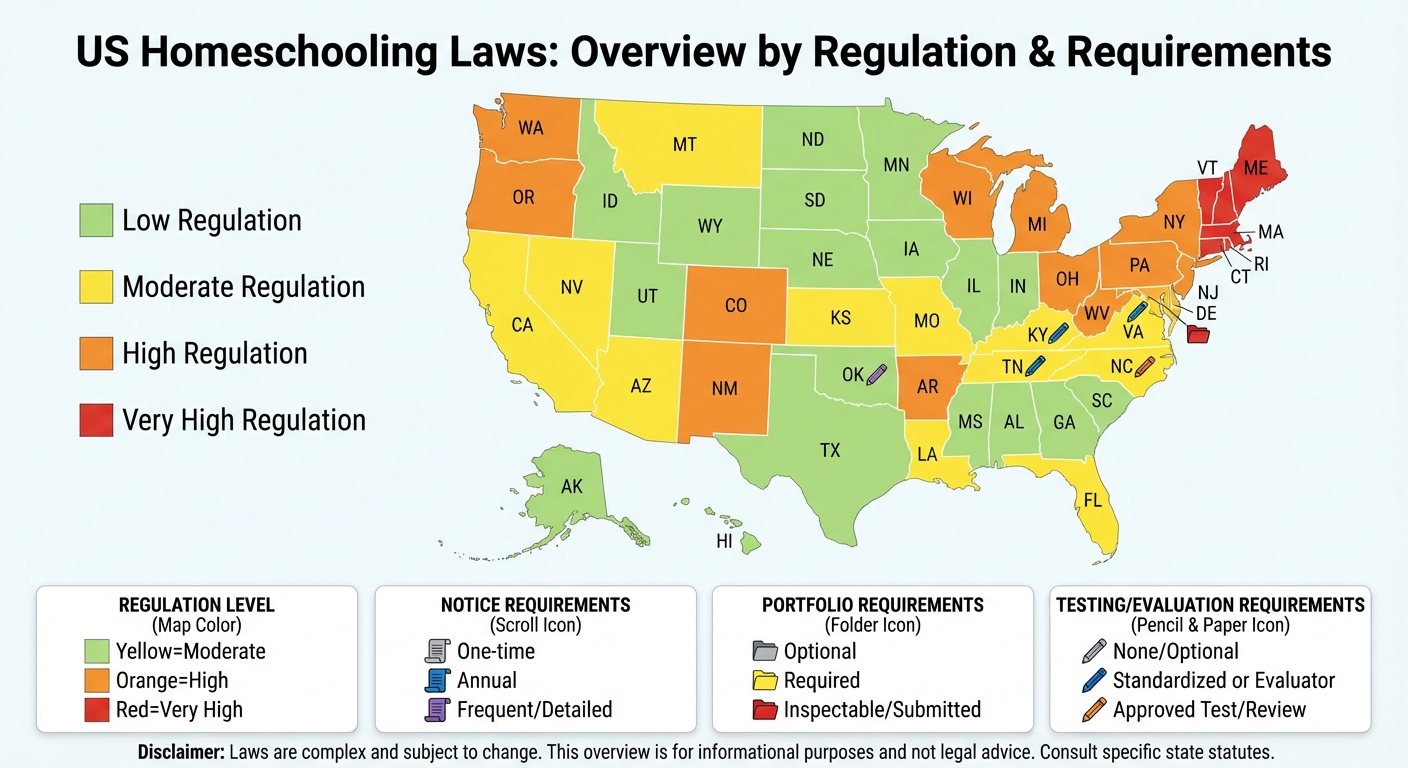
Before purchasing a single textbook, you need to know what your state requires. Homeschool laws vary dramatically across the United States, ranging from virtually no oversight to detailed reporting mandates.
States With Low Regulation
States like Texas, Alaska, and Idaho have minimal requirements. In Texas, for example, you do not need to notify anyone that you are homeschooling. You simply need to pursue a course of study that includes reading, spelling, grammar, math, and good citizenship in a bona fide manner.
States With Moderate Regulation
States such as Colorado, Florida, and Georgia require you to file a notice of intent and, in some cases, maintain attendance records or submit an annual evaluation. Florida requires an annual evaluation by a certified teacher or submission of standardized test results.
States With High Regulation
New York, Pennsylvania, and Massachusetts have the most detailed requirements. New York mandates an Individualized Home Instruction Plan (IHIP) filed with your local school district, quarterly reports, and annual assessments. Pennsylvania requires a notarized affidavit, a log of instruction hours, and a portfolio review by a certified evaluator.
How to Find Your State's Requirements
- Visit the Home School Legal Defense Association (HSLDA) for a state-by-state breakdown
- Contact your local school district's homeschool liaison
- Join a state-specific homeschool Facebook group or co-op — experienced families are the best resource for navigating local paperwork
Do not skip this step. Operating outside your state's legal framework can result in truancy charges or unwanted visits from child protective services. Fifteen minutes of research now saves enormous headaches later.
How to Legally Withdraw Your Child from Public School
If your child is currently enrolled in a public or private school, you will typically need to formally withdraw them before beginning homeschooling. Here is a general step-by-step process:
- Research your state's withdrawal process. Some states require a written withdrawal letter; others handle it through the homeschool notification process.
- Write a formal withdrawal letter. Address it to the school principal. State your child's name, grade, the effective date of withdrawal, and that you intend to homeschool. Keep a copy for your records.
- File your notice of intent to homeschool (if required by your state). This is separate from the withdrawal letter.
- Request your child's records. Ask for transcripts, immunization records, and any IEP/504 documentation.
- Return school property. Textbooks, library books, technology devices, uniforms, and ID badges.
- Get written confirmation. Ask the school for written acknowledgment that your child has been officially withdrawn.
A common mistake is simply stopping attendance without formally withdrawing. This can trigger truancy proceedings. Always follow the proper process.
Step 2: Choose a Homeschool Method
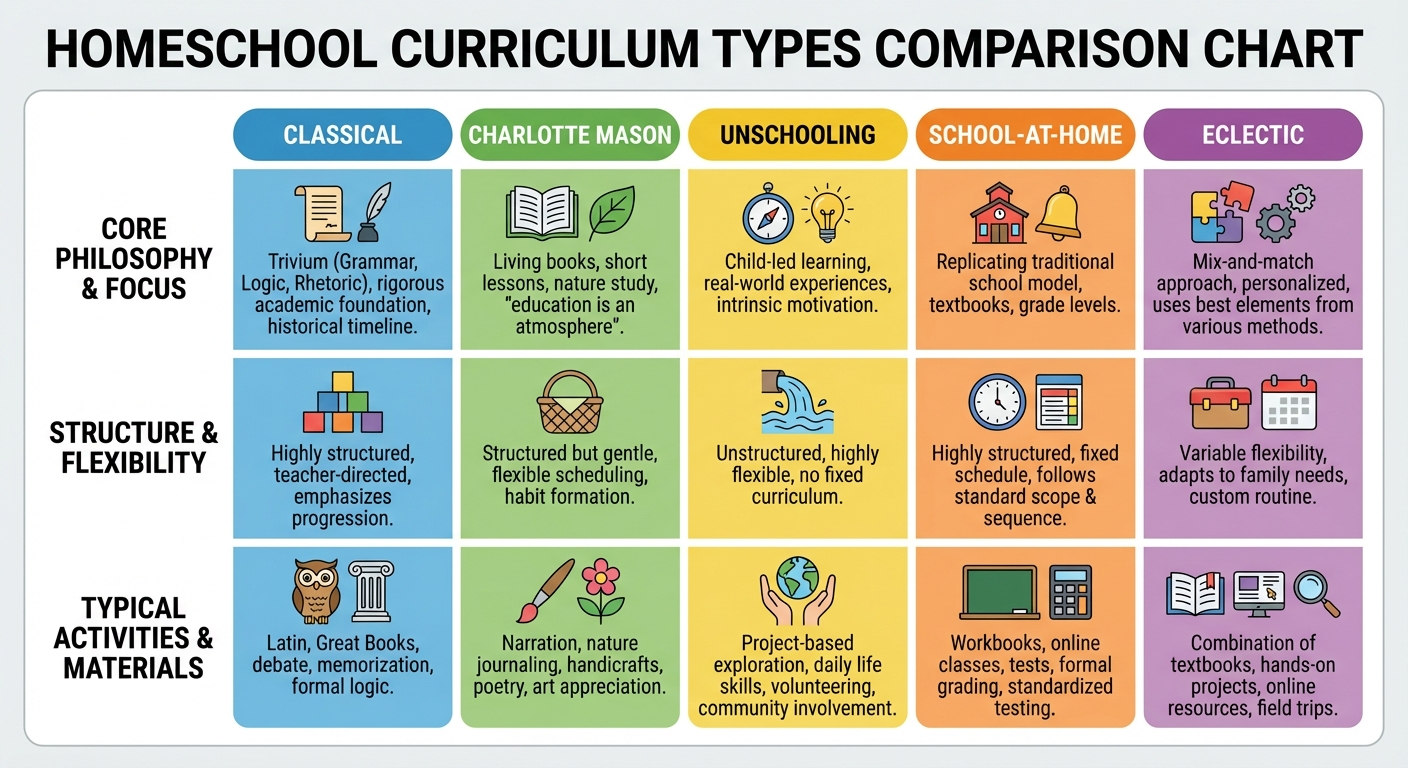
One of the biggest advantages of homeschooling is that you are not locked into a single teaching philosophy. Understanding the major approaches helps you select a method — or blend of methods — that matches your child's personality and your family's lifestyle.
Classical Education
Rooted in the medieval trivium, classical education moves through three stages: Grammar (memorization and facts in early years), Logic (analytical thinking in middle school), and Rhetoric (persuasive communication in high school). This method emphasizes great literature, Latin, and rigorous academic training. It works well for families who value structured, literature-rich learning.
Charlotte Mason
Charlotte Mason's philosophy centers on "living books" — real literature rather than textbooks — short focused lessons, nature study, narration, and habit training. Lessons are typically 15 to 20 minutes for younger children, making this approach ideal for kids with shorter attention spans. Many families love the emphasis on spending time outdoors and cultivating curiosity.
Montessori at Home
Evidence note: This comparison uses manufacturer specifications, published research, and independently reported owner feedback. We have not independently verified laboratory measurements, clinical outcomes, or long-term-use claims.
Unschooling
Unschooling follows the child's interests entirely. There are no set curricula or formal lessons. Instead, learning happens organically through life experiences, projects, and exploration. This approach requires significant trust in the process and works best for families comfortable with non-traditional assessment.
Eclectic / Relaxed Homeschooling
Most experienced homeschoolers land here eventually. Eclectic homeschooling borrows from multiple methods — perhaps a structured math curriculum combined with Charlotte Mason-style literature and unschooling for science. This flexibility is one of homeschooling's greatest strengths.
For a deeper look at structuring your days around these methods, check out our guide on creating a homeschool daily routine that actually works.
Step 3: Select Your Curriculum
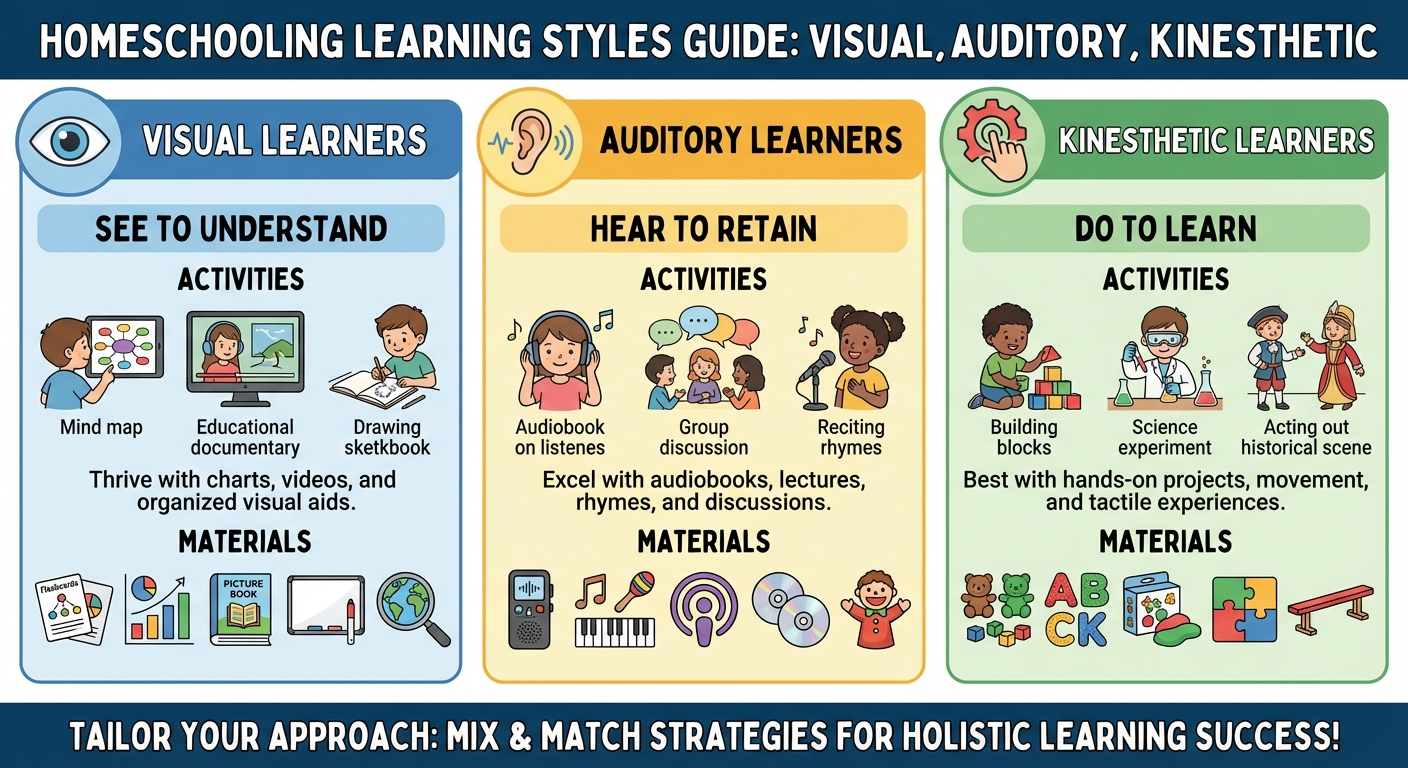
Choosing curriculum is where many new homeschoolers feel overwhelmed. There are hundreds of options, and the "best" one depends entirely on your child, your budget, and your teaching method.
All-in-One Curriculum Packages
Programs like Sonlight, Abeka, and Bookshark provide everything — textbooks, teacher guides, schedules, and assessments — in a single box. These are excellent for first-year homeschoolers who want structure and confidence that they are not missing anything.
Online and Digital Programs
Platforms like Khan Academy (free), Teaching Textbooks (math-focused), and Outschool (live online classes) give children screen-based instruction with built-in grading. These work well for subjects where you lack confidence, like advanced math or foreign languages.
Subject-Specific Favorites
Many veteran homeschoolers mix and match their favorite programs by subject:
- Math: Saxon Math, Singapore Math, or Math-U-See
- Language Arts: All About Reading, Institute for Excellence in Writing (IEW)
- Science: Real Science Odyssey, Apologia (faith-based), or The Good and the Beautiful
- History: Story of the World (elementary), Notgrass History (middle/high school)
Essential Curriculum Supplies
These foundational items make your first year significantly smoother:
📘 The Well-Trained Mind: A Guide to Classical Education at Home — The definitive guide for families considering classical education. Even if you choose a different method, the grade-by-grade breakdown of skills and subjects is invaluable for any homeschooler.
📗 Teach Your Child to Read in 100 Easy Lessons — A proven phonics-based reading program that has helped millions of children learn to read at home. Simple, scripted lessons require zero teaching experience.
📙 The Brave Learner: Finding Everyday Magic in Homeschool, Learning, and Life — Julie Bogart's practical guide helps parents move past perfectionism and find joy in the homeschool journey. Essential reading for any parent feeling anxious about whether they are "enough."
Step 4: Set Up Your Learning Space

You do not need a dedicated classroom. You need a consistent, distraction-reduced space where your child associates the environment with focused work.
The Essentials
- A sturdy table or desk with good lighting
- A comfortable chair at the proper height
- Storage bins or shelves for curriculum materials
- Basic supplies: pencils, erasers, crayons, scissors, glue, lined paper, a whiteboard
What You Do Not Need
- A separate room (the kitchen table works perfectly)
- Expensive furniture or classroom-style decorations
- Every supply on Pinterest homeschool boards
The most effective homeschool spaces are simple and functional. Many families rotate between the kitchen table for writing, the couch for read-alouds, the backyard for science, and the library for research. Variety keeps children engaged and breaks the monotony of sitting in one spot all day.
Creating Learning Zones
If space allows, designate areas by activity rather than by subject:
- Quiet focus zone — desk or table for writing, math, and individual work
- Reading nook — a comfortable corner with pillows and a bookshelf
- Creative station — art supplies, building materials, and messy-project space
- Outdoor classroom — patio table, garden beds, or a shaded yard area for nature study
Step 5: Create a Homeschool Schedule
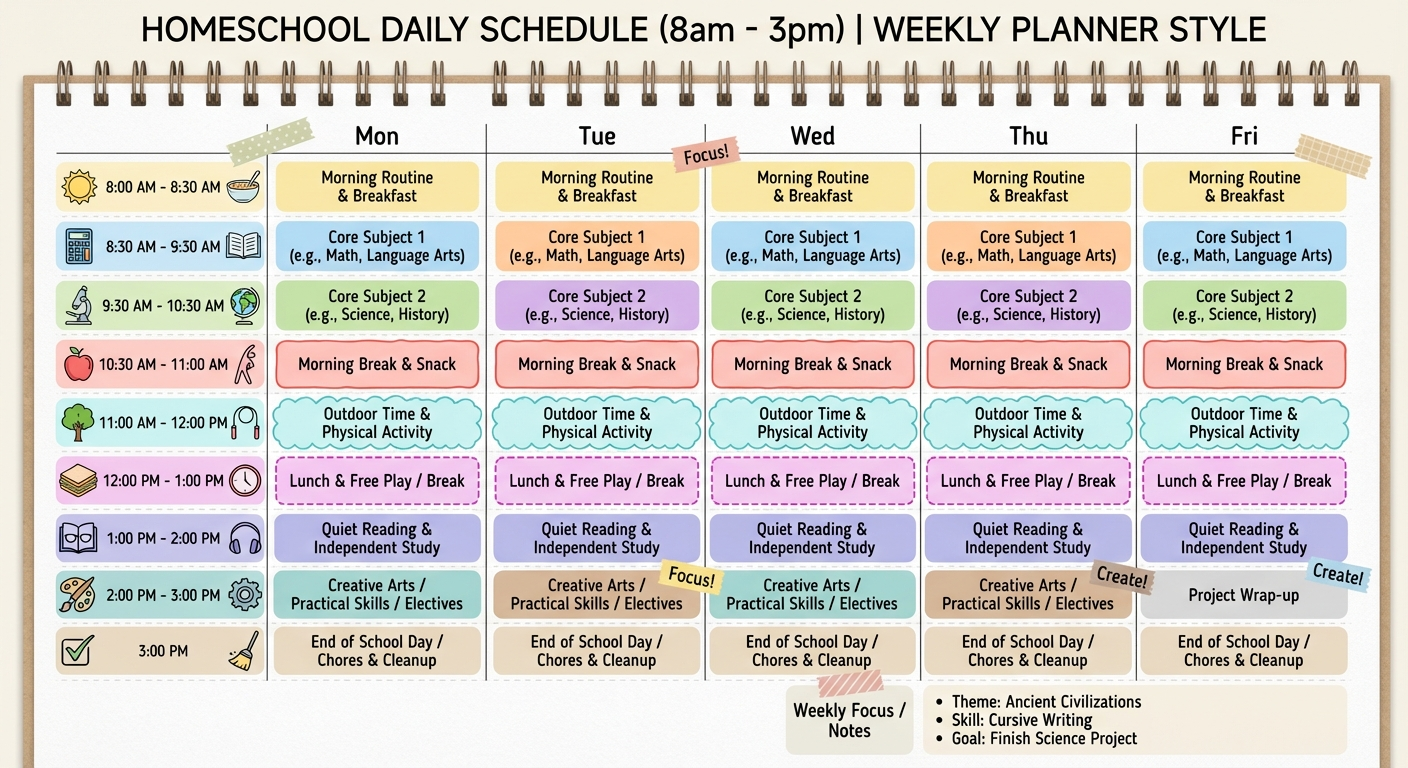
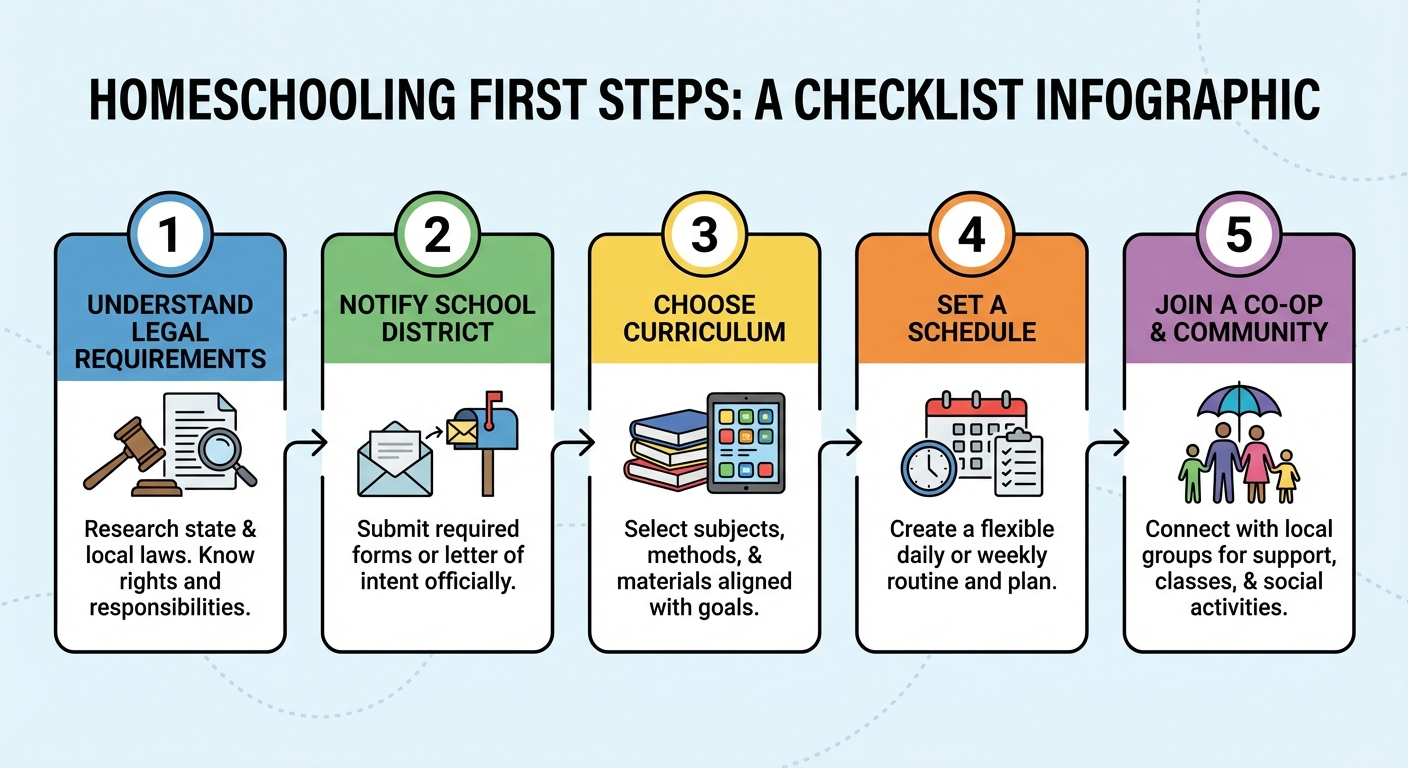
The number one mistake first-year homeschoolers make is trying to replicate a public school schedule at home. A six-hour school day includes transitions, lunch, recess, attendance, and managing 25 students. One-on-one instruction is dramatically more efficient.
Realistic Time Expectations by Grade
| Grade Level | Core Instruction Time | Total Including Enrichment |
|---|---|---|
| K–2nd | 1.5–2 hours | 2–3 hours |
| 3rd–5th | 2–3 hours | 3–4 hours |
| 6th–8th | 3–4 hours | 4–5 hours |
| 9th–12th | 4–5 hours | 5–6 hours |
These numbers surprise most new homeschoolers. Your child is not falling behind by finishing in two hours. They are finishing faster because they are not waiting for 24 other students to catch up.
Sample Elementary Schedule
- 8:30 AM — Morning basket (read-aloud, calendar, poetry)
- 9:00 AM — Math (30–45 min)
- 9:45 AM — Break / snack / free play (15 min)
- 10:00 AM — Language arts: reading, writing, spelling (45 min)
- 10:45 AM — Science or history (30 min, alternating days)
- 11:15 AM — Art, music, or nature study
- 12:00 PM — Done for the day
Block Scheduling for Older Students
Middle and high school students benefit from block scheduling — focusing on two or three subjects deeply per day rather than touching every subject daily. Monday/Wednesday might cover math and science, while Tuesday/Thursday handles language arts and history. This mimics college-style learning and builds focus.
The Loop Schedule Alternative
If a rigid daily plan stresses you out, try a loop schedule. List your subjects in order and work through them sequentially, picking up where you left off each day. If you only get through math and reading on Monday, you start with science on Tuesday. Nothing gets skipped permanently, but nothing is forced into an artificial daily box either.
VIDEO_EMBED: How to Create a Flexible Homeschool Schedule That Works for Your Family
Step 6: Address Socialization
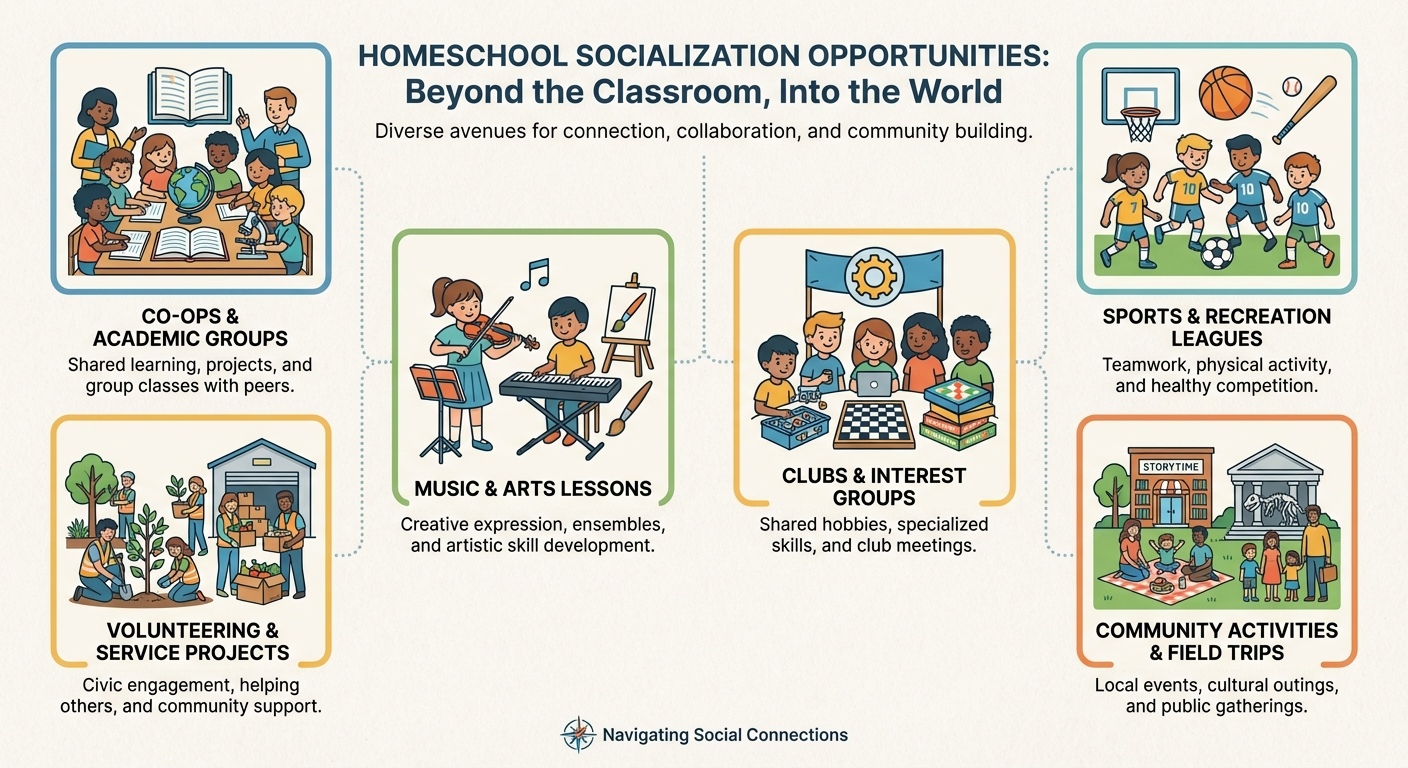
Let us address the elephant in every homeschool conversation. "What about socialization?" is the question every homeschool parent hears from well-meaning relatives, grocery store clerks, and strangers on the internet.
The research consistently shows that homeschooled children are not at a socialization disadvantage. A 2021 study published in the Journal of School Choice found that homeschooled students scored higher on measures of social skills, emotional regulation, and communication than their traditionally schooled peers.
The key difference is that homeschooled children socialize across age groups and in real-world settings, rather than being confined to a room of same-age peers for seven hours a day.
Socialization Opportunities
- Homeschool co-ops — Weekly group classes taught by rotating parents. Many co-ops offer science labs, art classes, drama, and PE.
- Community sports leagues — Most recreational leagues welcome homeschooled children. Many areas also have homeschool-specific sports teams.
- Scouts, 4-H, and youth groups — Structured programs that build leadership, teamwork, and community service skills.
- Music and art lessons — Private or group instruction provides mentorship and peer interaction.
- Library programs — Many public libraries offer homeschool-specific programming during weekday hours.
- Volunteer work — Older children gain real-world social skills through volunteering at animal shelters, food banks, or community gardens.
- Park days and field trips — Informal weekly gatherings where homeschool families meet at a park. Children play, parents connect, and friendships form naturally.
The truth is that socialization requires intentional effort from homeschool families, but the quality of those social interactions is often deeper and more diverse than what happens in a traditional classroom.
If you are wondering how to connect with other homeschool families near you, our guide to finding and joining a homeschool co-op walks you through every option.
Step 7: Track Progress and Assess Learning
Assessment in homeschooling does not have to mean bubble sheets and timed tests. In fact, authentic assessment — evaluating what your child can actually do — is far more valuable than standardized testing alone.
Portfolio Assessment
Keep a binder or digital folder for each child containing:
- Samples of their best work from each subject
- Photos of projects, experiments, and field trips
- Reading logs with titles and brief narrations
- Writing samples from the beginning and end of each semester
Portfolios provide concrete evidence of progress and are required in several states including Pennsylvania and Georgia.
Standardized Testing
Some states require annual standardized testing. Even if yours does not, periodic testing provides useful data points. Common options include the Iowa Test of Basic Skills (ITBS), the Stanford Achievement Test (SAT-10), and the CAT (California Achievement Test), which can be administered at home by a parent.
Narration and Discussion
Charlotte Mason practitioners rely heavily on narration — asking the child to tell back what they learned in their own words. This is one of the most effective forms of comprehension assessment ever developed. If a child can explain a concept clearly, they understand it. If they cannot, you know exactly where the gap is.
Grading and Transcripts
For high school students, you will need to create transcripts for college applications. Many homeschool parents assign grades using a standard scale and maintain a running GPA. Several free transcript templates are available through HSLDA and homeschool curriculum providers.
Homeschooling Costs: What to Expect
Homeschooling can cost almost nothing or several thousand dollars per year, depending on your choices.
Budget Breakdown
| Expense Category | Budget Option | Mid-Range | Premium |
|---|---|---|---|
| Curriculum | $0–$200 (library + free online) | $500–$1,000 (mix of paid + free) | $1,500–$3,000 (boxed curriculum) |
| Supplies | $50–$100 | $100–$250 | $250–$500 |
| Extracurriculars | $0–$200 (community programs) | $500–$1,500 (co-op fees, sports) | $2,000+ (private lessons, travel teams) |
| Testing / Evaluation | $0–$50 | $50–$150 | $150–$300 |
| Field Trips | $50–$200 | $200–$500 | $500+ |
| Annual Total | $100–$750 | $1,350–$3,400 | $4,400–$7,800+ |
Free and low-cost resources that dramatically reduce spending:
- Khan Academy — Free, world-class math, science, and humanities instruction
- Ambleside Online — Free Charlotte Mason curriculum covering all subjects K–12
- Easy Peasy All-in-One Homeschool — Complete free curriculum with daily assignments
- Your public library — Interlibrary loan systems give you access to virtually any book published
- YouTube educational channels — Crash Course, SciShow, National Geographic, and hundreds of others
Common Mistakes New Homeschoolers Make
Learning from others' missteps saves you months of frustration. These are the pitfalls that trip up nearly every first-year family.
Trying to Replicate School at Home
Your home is not a classroom, and you are not a public school teacher managing 25 students. Do not buy a bell, assign homework, or force your child to sit at a desk from 8 AM to 3 PM. The entire advantage of homeschooling is that it does not look like school.
Buying Too Much Curriculum
First-year parents panic-buy. They order three math programs, two reading curricula, and enough science kits to outfit a laboratory. Start with one solid program per core subject. You can always add later, but you cannot un-spend money on curriculum gathering dust on a shelf.
Comparing to Other Families
Social media homeschool accounts show spotless schoolrooms, color-coded planners, and children in matching outfits doing watercolor at sunrise. That is not real life. Your child reading on the couch in pajamas while you teach fractions with pizza at the kitchen counter is just as valid and probably more effective.
Neglecting Your Own Wellbeing
Homeschooling is a marathon. Parents who burn out in the first semester tried to be everything — teacher, administrator, curriculum designer, social coordinator — without rest. Schedule breaks. Use co-op days for your own errands. Accept that some days will be survival mode, and that is perfectly acceptable.
Ignoring Record-Keeping
Even in low-regulation states, maintaining basic records protects you legally and helps you track progress. Keep a simple log of what you covered each week. It takes five minutes and provides peace of mind.
Homeschool Methods Comparison Table
Evidence note: This comparison uses manufacturer specifications, published research, and independently reported owner feedback. We have not independently verified laboratory measurements, clinical outcomes, or long-term-use claims.
See also: habit tracker apps for building consistent homeschool routines
Frequently Asked Questions
Do I need a teaching degree to homeschool?
No. No state in the United States requires a teaching degree to homeschool your own children. Some states require a high school diploma or GED, but most have no educational requirements for the parent at all. You know your child better than any credentialed stranger. That knowledge, combined with a good curriculum and willingness to learn alongside your child, is more than sufficient.
Can I homeschool if I work full time?
Yes, though it requires creative scheduling. Many working parents homeschool in the evenings, on weekends, or during non-traditional hours. Others use online programs that allow children to work independently while the parent is at work. Some families split teaching duties between two parents, a grandparent, or a homeschool co-op. Flexible and asynchronous curricula make working-parent homeschooling far more achievable than it was a decade ago.
How do homeschooled students get into college?
Homeschooled students are actively recruited by many colleges and universities. Institutions including Harvard, MIT, Stanford, and state universities across the country accept homeschool applicants. You will need to prepare a transcript, provide standardized test scores (SAT or ACT), and potentially submit a portfolio or additional documentation. Many admissions officers report that homeschooled applicants demonstrate exceptional self-direction and writing skills.
What if my child has special needs?
Homeschooling can be an excellent option for children with special needs because instruction is fully individualized. However, withdrawing from public school may mean losing access to IEP services and therapies provided by the school district. Before withdrawing, consult with your child's current team and research whether your state allows homeschooled students to access public school services on a part-time basis. Many states do offer this option.
Is homeschooling legal in all 50 states?
Yes. Homeschooling is legal in all 50 states and all U.S. territories. However, the regulations vary significantly. Some states require nothing more than a statement of intent, while others require detailed curriculum plans, standardized testing, and professional evaluations. Always verify your specific state requirements before beginning.
How do I homeschool multiple children at different grade levels?
This is one of homeschooling's hidden strengths. Subjects like history, science, art, and music can be taught to all children simultaneously at a general level, with age-appropriate assignments for each child. Only math and language arts typically need grade-specific instruction. Unit studies and loop schedules are particularly effective for multi-age families.
{
  "@context": "https://schema.org",
  "@type": "Article",
  "headline": "How to Start Homeschooling: Complete Beginner's Guide (2026)",
  "description": "Learn how to start homeschooling step by step. This beginner's guide covers legal requirements, curriculum choices, scheduling, socialization, and everything you need to teach your children at home.",
  "image": "/images/how-to-start-homeschooling-hero.jpg",
  "author": {
    "@type": "Organization",
    "name": "Plan Homeschooling Editorial Team"
  },
  "publisher": {
    "@type": "Organization",
    "name": "Plan Homeschooling",
    "url": "https://planhomeschooling.com"
  },
  "datePublished": "2026-03-18",
  "dateModified": "2026-03-18",
  "mainEntityOfPage": {
    "@type": "WebPage",
    "@id": "https://planhomeschooling.com/how-to-start-homeschooling"
  }
}
{
  "@context": "https://schema.org",
  "@type": "FAQPage",
  "mainEntity": [
    {
      "@type": "Question",
      "name": "Do I need a teaching degree to homeschool?",
      "acceptedAnswer": {
        "@type": "Answer",
        "text": "No. No state in the United States requires a teaching degree to homeschool your own children. Some states require a high school diploma or GED, but most have no educational requirements for the parent at all."
      }
    },
    {
      "@type": "Question",
      "name": "Can I homeschool if I work full time?",
      "acceptedAnswer": {
        "@type": "Answer",
        "text": "Yes, though it requires creative scheduling. Many working parents homeschool in the evenings, on weekends, or during non-traditional hours. Others use online programs that allow children to work independently while the parent is at work."
      }
    },
    {
      "@type": "Question",
      "name": "How do homeschooled students get into college?",
      "acceptedAnswer": {
        "@type": "Answer",
        "text": "Homeschooled students are actively recruited by many colleges and universities. Institutions including Harvard, MIT, Stanford, and state universities accept homeschool applicants. You will need to prepare a transcript, provide standardized test scores (SAT or ACT), and potentially submit a portfolio."
      }
    },
    {
      "@type": "Question",
      "name": "What if my child has special needs?",
      "acceptedAnswer": {
        "@type": "Answer",
        "text": "Homeschooling can be an excellent option for children with special needs because instruction is fully individualized. Before withdrawing from public school, consult with your child's current team and research whether your state allows homeschooled students to access public school services part-time."
      }
    },
    {
      "@type": "Question",
      "name": "Is homeschooling legal in all 50 states?",
      "acceptedAnswer": {
        "@type": "Answer",
        "text": "Yes. Homeschooling is legal in all 50 states and all U.S. territories. However, the regulations vary significantly from state to state."
      }
    },
    {
      "@type": "Question",
      "name": "How do I homeschool multiple children at different grade levels?",
      "acceptedAnswer": {
        "@type": "Answer",
        "text": "Subjects like history, science, art, and music can be taught to all children simultaneously at a general level, with age-appropriate assignments for each child. Only math and language arts typically need grade-specific instruction."
      }
    }
  ]
}
Sources
- National Center for Education Statistics. "Homeschooling in the United States." NCES, U.S. Department of Education. https://nces.ed.gov/nhes/homeschooling.asp
- Home School Legal Defense Association. "Homeschool Laws by State." HSLDA. https://hslda.org/legal
- Ray, Brian D. "Research Facts on Homeschooling." National Home Education Research Institute, 2024. https://www.nheri.org/research-facts-on-homeschooling/
- Medlin, Richard G. "Homeschooling and the Question of Socialization Revisited." Peabody Journal of Education, vol. 88, no. 3, 2013, pp. 284–297.
- Murphy, Joseph. "Homeschooling in America: Capturing and Assessing the Movement." Corwin Press, 2012.
- Guterman, Oz, and Ari Neuman. "Schools and Emotional and Behavioral Problems: A Comparison of School-Going and Homeschooled Children." Journal of School Choice, vol. 15, no. 1, 2021, pp. 5–26.
- Texas Education Agency. "Texas Homeschool Information." https://tea.texas.gov/texas-schools/general-information/texas-private-schools/texas-private-schools
- New York State Education Department. "Home Instruction." http://www.nysed.gov/curriculum-instruction/home-instruction